Built for therapists
Find the CBT worksheet you need, ready for your next session.
Search 200+ resources and, with a free account, download a PDF or draw a formulation with your client. When you want to, send homework as a link and read the answers before you meet.
Your clients don’t need an account.
Formulation at the heart of the work.
Choice in how you work together.

Cross-sectional formulation
Fictional example
Choose an area to highlight its connections. Select it again or press Escape to reset.
- Situation / trigger leads to thoughts.
- Situation / trigger leads to emotions.
- Situation / trigger leads to physical sensations.
- Thoughts connect in both directions with emotions.
- Thoughts connect in both directions with physical sensations.
- Emotions connect in both directions with physical sensations.
- Thoughts lead to behaviour.
- Emotions lead to behaviour.
- Physical sensations lead to behaviour.
Choose an area to follow its connections.
AI-generated illustrative photograph. Formulation example uses fictional data.
- 200+ resourcesFor the work in and between sessions
- Online or on paperChoose what works for your client
- Your clinical judgementTools to support the conversation
From shared understanding to the next step.
Choose homework that fits your formulation, share a link with your client, and return to their online responses together.
For your client
A link. A place to return to.
Assigned homework and shared resources, together. Your client opens their workspace from a link, without creating an account.
Try the thought record
A client’s thought record
Room for their experience.
Your client records a situation, their feelings and their thoughts in their own words. Here, the example is speaking in a team meeting.
Try the thought record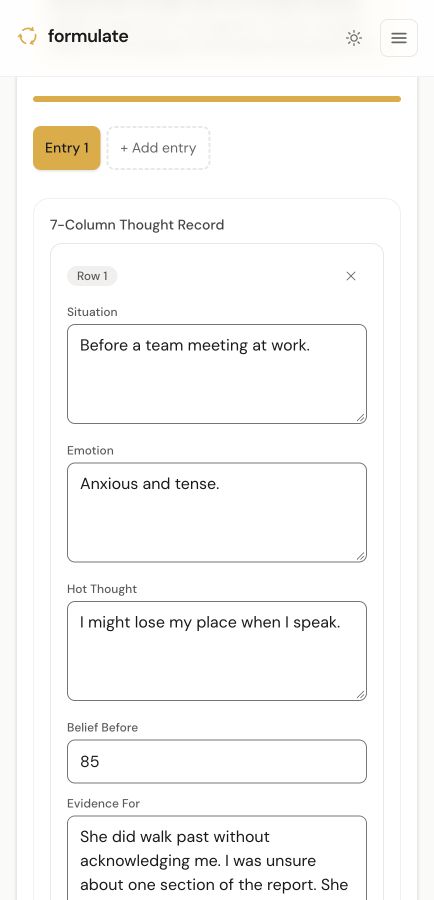
For you, the therapist
Their words. Ready to review.
Read the online response and return to it together in your next conversation. This review continues the fictional team-meeting example.
Explore the homework workflow
Illustrative examples with fictional data. The workspace is a separate demonstration; the thought-record entry and review share the same situation, feelings and hot thought.
A resource for the next step
Start with what matters
in the room.
Browse 200+ resources for formulation and between-session work. Here are three places to begin.
Browse the library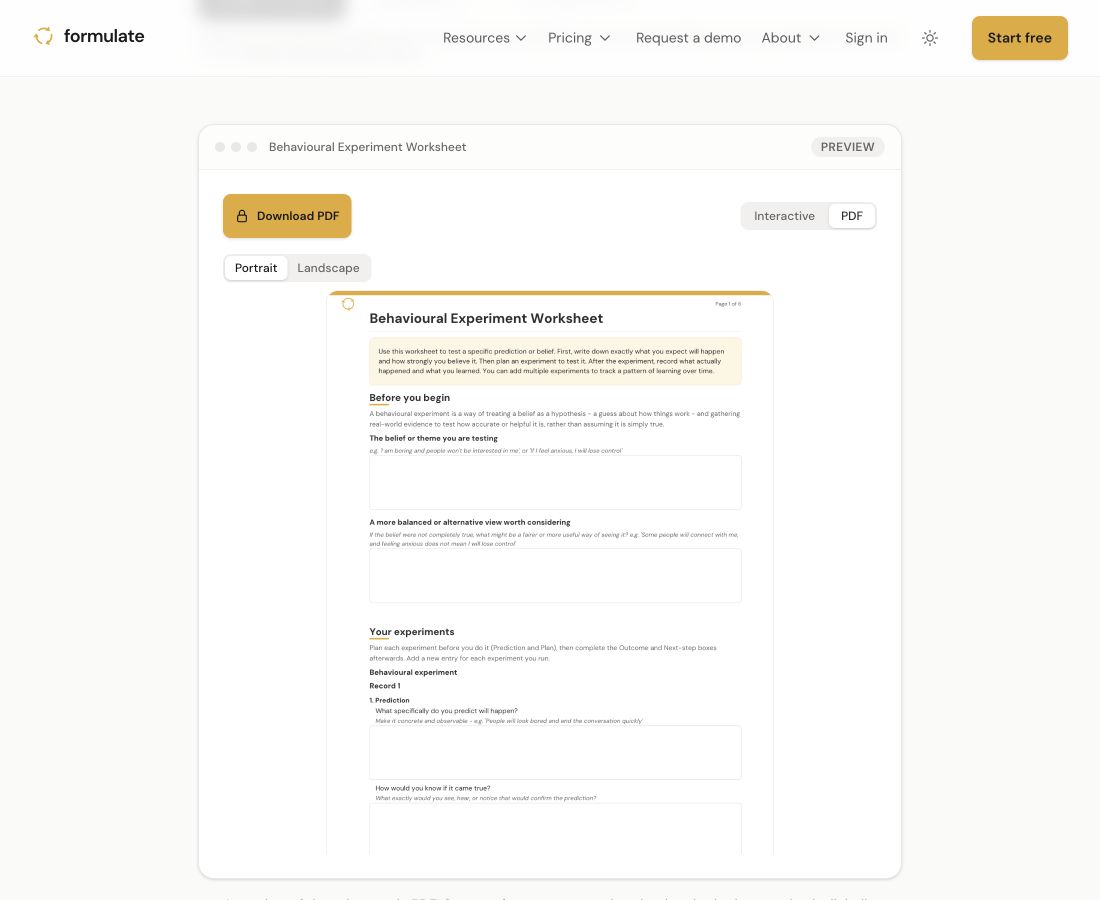
Behavioural experiment
Plan a way to test a prediction and reflect on what happened.
View the resource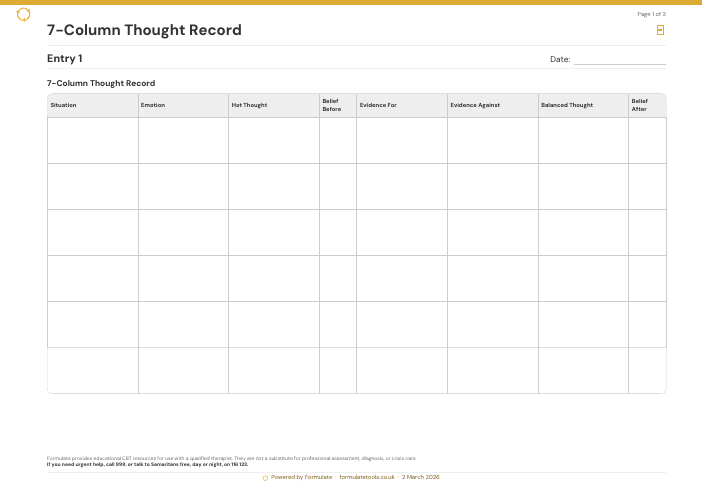
Thought record
Explore a thought, weigh the evidence and consider another perspective.
Try the interactive tool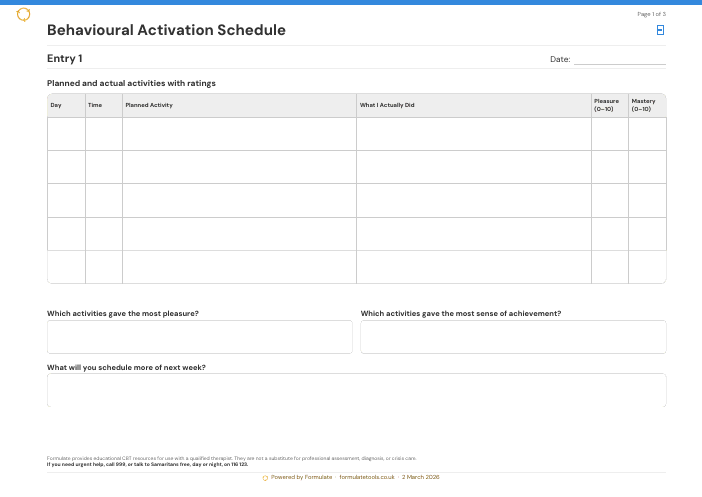
Activity schedule
Plan activities and record experiences of pleasure and mastery.
Open the client exampleClinical content, with context
Know what informs
the work.
Our formulation pages name the models’ authors and list their primary sources, so you can explore the thinking behind each resource.
Explore the models and sources →From the cross-sectional formulation resource
Cross-sectional formulation
Padesky & Mooney · 1990
Clinical tip: Presenting the cognitive model to clients
International Cognitive Therapy Newsletter, 6, 13–14
Read the resource and its sources ↗
Founded byTarun VermaniTrainee Clinical Psychologist
Read how clinical content is written, reviewed and corrected, and who is responsible for it.
People and editorial policy →Make it part of your practice
Start with your
next session.
Create your free account, choose one resource, and see how it fits the way you and your clients work.
Try Practice free for 14 days, then continue on the Free plan. No card required. Free includes 10 worksheet uses per 30-day period.
Compare plans ↗Starter: £4.99/mo, or £3.99/mo billed annually (£47.90/year).
A few practical questions
Do my clients need an account?
No. You share a homework or workspace link with your client. They can open it on their phone, tablet or computer without creating an account.
Can we still work on paper?
Yes. Download a blank PDF to complete on paper, or share a worksheet to complete online. Choose the format that suits the work and your client.
What happens after the trial?
every new account includes a 14-day trial of the Practice plan, with no credit card required. During the trial you get unlimited worksheet use, unlimited clients, and the full Practice feature set. When it ends, your account simply moves to the free tier (10 worksheet uses per month) unless you choose to upgrade — nothing is deleted.
What does the Free plan include?
Use 10 different worksheets per 30-day period, with up to 3 clients and 3 pieces of homework active at a time. Returning to the same worksheet during that period does not use another allowance.